



What is artificial intelligence?
An analysis of the most used term in 2024.


The truth is that "artificial intelligence" is a term with many meanings. Britannica defines artificial intelligence (or “AI”) as:
"Artificial intelligence (AI) [is] the ability of a digital computer or computer-controlled robot to perform tasks commonly associated with intelligent beings."
SNL however, defines artificial intelligence as:
"Artificial intelligence is information technology that adjusts its own activity and therefore appears to be intelligent."
PwC in turn, defines artificial intelligence as:
"Artificial intelligence (AI), or "Artificial Intelligence (AI)" in English, is about developing computer systems that can learn from their own experiences and solve complex problems in various situations and environments. If a machine can solve problems, perform a task or display other cognitive functions that a human can, then we can say that it has artificial intelligence."
PwC also refers to regjeringen.no, which has the following definition:
"Artificially intelligent systems perform actions, physical or digital, based on the interpretation and processing of structured or unstructured data, with the intention of achieving a given goal."
All these definitions are problematic. First of all, it is not the case that artificial intelligence must be able to learn and adjust its own behavior. For example, let's say we have an artificial intelligence that drives a car perfectly, but has no ability to learn (from mistakes). The latter shortcoming will not disqualify it from being considered an artificial intelligence by anyone who sees its superior driving skills.
There are obviously also a number of machines that can solve so-called human problems which, at least in a historical context, cannot be considered artificial intelligence. For example, a weaving machine.
The government's definition is also problematic. There is little difference between the government's definition of "artificially intelligent systems" and an arbitrary definition of a computer program. It's also long, hard to remember, and why mention both structured and unstructured data when both are included?
At the same time, this is precisely the problem with "artificial intelligence": it is a broad term that encompasses a lot. It is therefore difficult to define.
English Wikipedia's definition illustrates this well:
"Artificial intelligence (AI), in its broadest sense, is intelligence exhibited by machines, particularly computer systems."
Translated into Norwegian:
Artificial intelligence (AI), in its broadest sense, is intelligence exhibited by machines, specifically computers.
Actually, we have only reduced the problem of definition to defining "intelligence". At the same time, this is a question we have a greater intuitive understanding of. By accepting that "artificial intelligence" is intelligence in the context of machine performance, and possibly specifically in the context of computers, we have a definition that is easy to relate to and easy to remember.
To substantiate our definition and convince us that it makes sense, here we give a number of examples that I think we can agree are "artificial intelligence":
- ChatGPT.
- Midjourney and Dall-E.
- Self-driving cars.
- Chess programs that easily crush the world's best chess players (sorry Magnus). Ev. Go programs that crush the world's best Go players, if you prefer Go over chess.
- Tesla's new Optimus robot.
- Chatbots on websites, which are never able to help you with what you actually need.
- Fully digital assistants that perform tasks at your command.
History
Artificial intelligence
Few disciplines have such a defined start as artificial intelligence. In 1956, John McCarthy gathered a group of academics for what became known as the Dartmouth Summer Research Project on Artificial Intelligence. The project's formal description, written by McCarthy and others, gives a good indication of what they thought AI was and should be:
We propose that a 2-month, 10-man study of artificial intelligence be carried out during the summer of 1956 at Dartmouth College in Hanover, New Hampshire. The study is to proceed on the basis of the conjecture that every aspect of learning or any other feature of intelligence can in principle be so precisely described that a machine can be made to simulate it. An attempt will be made to find how to make machines use language, form abstractions and concepts, solve kinds of problems now reserved for humans, and improve themselves. We think that a significant advance can be made in one or more of these problems if a carefully selected group of scientists work on it together for a summer. [1]
The term "Artificial Intelligence" was specifically coined by McCarthy for the occasion.
Turing and the turing test
Before this, mathematician Alan Turing had already done extensive research on thinking machines. One of the ideas he is best known for is the Turing test, introduced in the article Computing Machinery and Intelligence, published in 1950.
The Turing test is a test that indicates whether a machine possesses intelligence that is indistinguishable from the intelligence of a human. The idea in the tests is that a judge, a human, observes natural language between a machine and a human. The judge knows that one of the contestants is a machine (this is not made clear in Turing's original script). If the judge is unable to distinguish who is human and who is machine, the turing test has been passed.
The Turing test has and is an important component in the world of artificial intelligence. At the recent launch of ChatGPT, it didn't take long to check whether it passes the Turing test. Something it does[2].
Neural networks
Basic networking
Much research within artificial intelligence deals with what is called "neural networks".
In the context of artificial intelligence, a neural network is a computer model that is inspired by biological neural networks in animals.
The networks work by having a number of nodes (which imitate neurons) and a multitude of connections between the nodes (mimicking synapses).
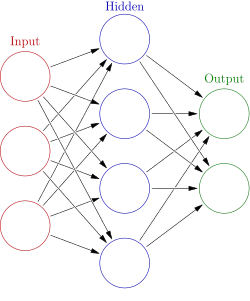
A distinction is typically made between three layers in a classical neural network: the input layer ("input layer"), the hidden layer ("hidden layer") and the output layer ("output layer").
Numbers are sent into the neural network. First to the incoming team. When a node receives a number, it takes the numbers it has received, passes the numbers through a formula called a activation function, which calculates a new number which is the output value the node should pass on. This value is passed on over all the outgoing links from the node.
This simulates how our brain works. In the brain, electrical impulses are sent between our neurons. Each neuron has a built-in activation function, which is more complex than the models we typically use in artificial neural networks. When a neuron receives an electrical impulse, whether or not it sends an impulse on, and the strength of this impulse, will vary depending on the neuron's internal “activation function”.
Weighting
The connections between the nodes (preferably called "edges" in English) all have a numerical value. This value is called a weight. This weight indicates how strong a link is between two nodes. A number sent out from one node to another will be multiplied by the weight of the edge between the nodes.
When creating a neural network to solve a task, there are in practice two jobs you have to do:
- Design the network. How many nodes should we have, and how should they be connected to each other?
- Put weights on all the edges.
In principle, this is all that is needed. The problem is that there are an awful lot of networks you can create, and an infinite amount of different numbers you can put on the scales.
So how do you choose the right weights?
Learning and Backpropagation
To set the correct weights on a neural network, you have to train the network.
Say, for example, that you have a network that you want to detect whether an image contains a cat or not. The input nodes of the network can be set up to receive the pixels of the images. You therefore need one node per pixel, and if you have images of different sizes, you must normalize them. There can be one outgoing node which is interpreted so that if the node has the value 1, there is a cat in the picture, and if the node has the value 0, there is no cat in the picture.
To train this network, one often prepares thousands of images of cats (if not more) and thousands of images without cats. For each image, you have a sequence (vector) of numbers that represent the pixels of the image, and a number 0 or 1 that indicates whether the image contains a cat or not. This is the training data of the network.
We then run each image through our network, which has typically been set up with completely random weights on the edges. On the other side, we get a value that indicates whether the network thinks there is a cat in the image or not. At first, this network is likely to predict completely wrong. For driving, we can do a process called Backpropagation. This takes the value that came out of the network (which is probably not exactly what we expect), and "propagates" the error backwards in the network, adjusting each edge so that the error is smaller on the next run. How much each edge is adjusted each time is called the learning rate of the training.
Backpropagation is what allows us to train neural networks on large amounts of data, and with that few they do the most incredible things. Without backpropagation, each number in a network would have had to be set manually or in some other systematic way by the engineers creating the networks.
For ChatGPT-4, there are around 1,800 billion such numbers that need to be trained. In other words, something that is completely inaccessible to carry out manually.
Backpropagation was first published by Seppo Linnainmaa in 1970[3].
Universality
Neural networks are useful tools for solving complex problems. Since we can train the networks on large amounts of data, it is easy to imagine that all problems can be transformed into training data and trained on a network.
This is a thought that also has some support in mathematics. Neural networks are namely universal function approximators. Simply summarized, this means that neural networks can in theory mimic arbitrary mathematical functions. And since arbitrary mathematical functions can largely describe most problems we want to solve in the computing world, neural networks can also do this.
This is called universality.
However, important secondary questions are: A) How easy is it to approximate a function (a problem) with a neural network, B) Do we have enough training data? and C) Are there easier ways to solve the problem?
The answer to these questions can often point to the fact that neural networks are not the right method for solving a certain problem.
Build the future of your product with zero headaches
From MVP prototypes to scalable platforms, our full-stack dev team turns your roadmap into rock-solid code. Get to market faster without sacrificing quality.
Get started

